Halloween is supposed to be scary because of the costumes.
Not because your kid dressed as a six-foot inflatable dinosaur just sprinted across a dark street after spotting a house with full-size candy bars.
Most Halloween safety isn’t complicated. It’s the normal stuff parents already know, except Halloween combines darkness, excited kids, costumes that weren’t designed for walking, crowded streets and an impressive amount of sugar into one evening.
So before everyone heads out, here’s a quick Halloween safety check worth running through.
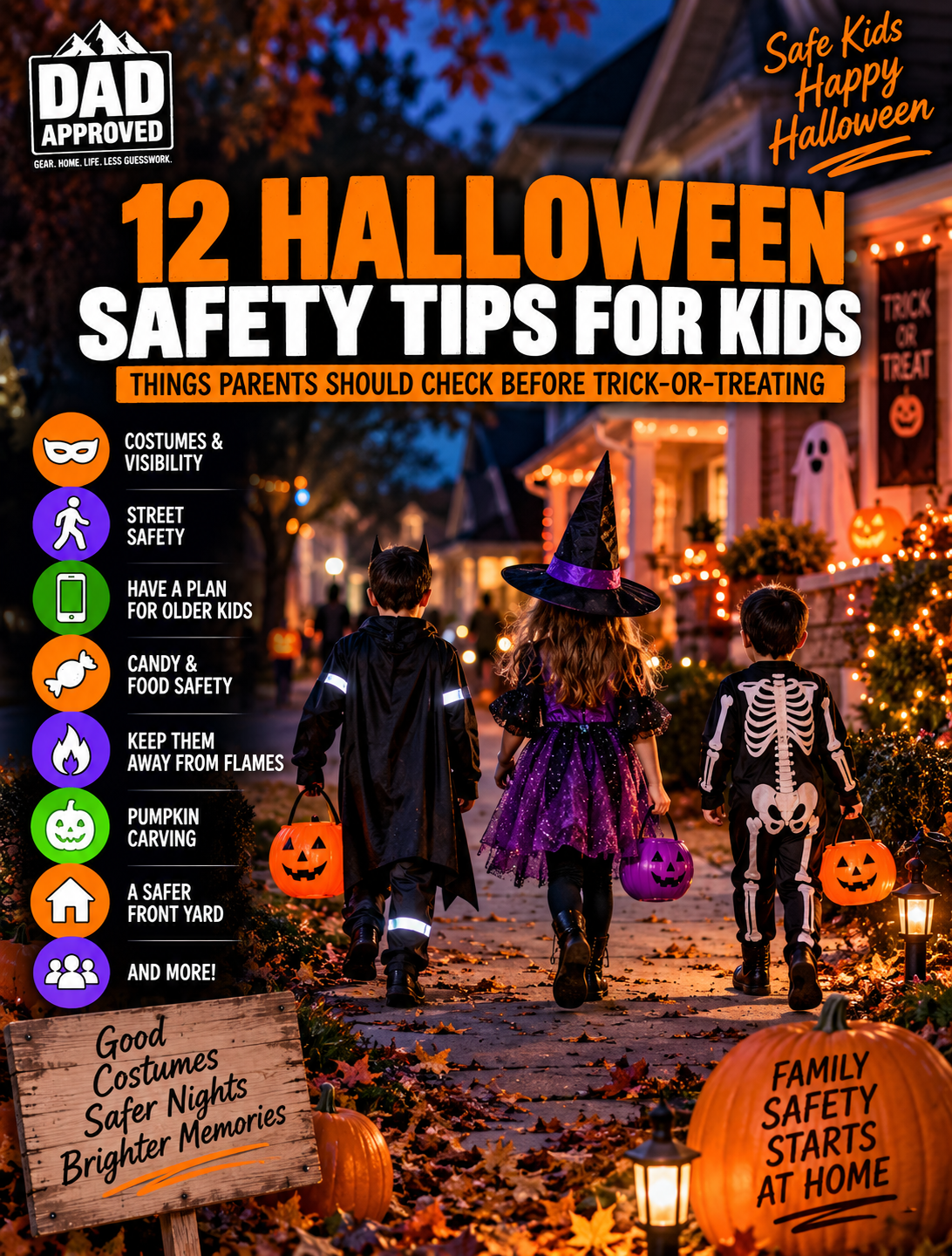
1. Make Sure They Can Actually See in the Costume
That elaborate mask may look fantastic in the kitchen.
Try walking around outside in it.
Masks, hats and costume accessories shouldn’t interfere with a child’s ability to see or move safely. The American Academy of Pediatrics recommends choosing costumes that fit properly and avoiding accessories that are sharp or excessively long.
Have your child put on the entire costume, including the shoes and mask, and walk around before Halloween night.
If they can’t see their own feet, we’re already negotiating with gravity.
2. Check the Costume Length
A costume that looks great standing still might be a completely different story after walking three blocks.
Make sure nothing drags around the ankles or makes climbing steps difficult. Shoes should also be comfortable enough for actual walking.
Remember, trick-or-treating isn’t standing around looking cool in a costume.
Kids are going to walk.
And walk.
And then suddenly discover an entirely new reserve of energy when somebody says the next neighborhood gives out better candy.
3. Make Them Visible
Dark costumes look appropriately spooky.
They also look appropriately invisible to drivers.
The American Academy of Pediatrics recommends bright or reflective costumes when possible and suggests adding reflective tape or striping to costumes and trick-or-treat bags. Flashlights can also help kids see and be seen. Their Halloween safety recommendations cover costumes, visibility, pedestrian safety and other trick-or-treating precautions.
You don’t have to turn your tiny vampire into a highway construction worker.
Just make sure cars can see him.
4. Establish the Street-Crossing Rules Before You Leave
Halloween excitement has an interesting effect on a child’s ability to remember that streets exist.
Go over the rules before you start.
Use sidewalks where they’re available. Cross streets carefully at intersections or crosswalks rather than darting between parked vehicles. Remind kids to look before crossing, even when there’s a particularly impressive inflatable ghost waiting on the other side.
This is one of those conversations that’s considerably easier to have before everyone is carrying a bucket full of candy.
5. Give Older Kids an Actual Plan
Eventually kids reach the age where walking three feet behind Dad becomes socially devastating.
If older children are trick-or-treating without you, establish the plan first.
Know who they’re going with, where they’re going, when they’re coming home and how you’ll contact each other.
The American Academy of Pediatrics recommends that older children going without an adult travel in groups and use the buddy system.
“Somewhere around the neighborhood with some people” is not a route.
6. Charge the Phones Before Everyone Leaves
This one takes approximately ten seconds to check.
If your child is old enough to trick-or-treat independently and carries a phone, make sure it’s actually charged before leaving.
A phone sitting at 4% battery while displaying fourteen notifications isn’t quite the emergency communication device we’re looking for.
7. Feed Them Before Trick-or-Treating
This might be my favorite piece of official Halloween advice because every parent immediately understands why it works.
Feed the kids first.
The FDA recommends giving children a light meal or snack before trick-or-treating so they’re less tempted to start eating their candy before you’ve had a chance to inspect it. Their Halloween food safety guidance for parents also covers inspecting treats, food allergies and choking hazards.
Will this prevent them from eating seventeen pieces later?
Let’s not ask Halloween to perform miracles.
8. Check the Candy Before They Eat It
You don’t need to conduct a forensic investigation under a desk lamp.
Give everything a reasonable look.
The FDA recommends checking commercially wrapped treats for unusual appearance, discoloration, tears, tiny holes or other signs that packaging may have been compromised.
Anything suspicious gets tossed.
For younger children, also watch for candy, toys or other treats that could present a choking hazard.
9. Pay Extra Attention to Food Allergies
If your child has a food allergy, Halloween requires a little more label reading than usual.
Don’t rely on what a candy normally contains or assume that every version of a familiar product has identical ingredients.
Check the package before your child eats it.
The FDA also advises parents of children with food allergies to carefully examine labels and avoid homemade treats when the ingredients aren’t known.
It’s considerably easier to disappoint a kid over one piece of candy than deal with an allergic reaction.
10. Keep Real Flames Away From Costumes
Jack-o’-lanterns look great with candles.
Battery-powered lights look considerably better than explaining to the fire department how Batman’s cape caught fire.
The American Academy of Pediatrics recommends using flashlights or glow sticks for trick-or-treating and keeping children away from open flames.
For pumpkins and decorations around areas where kids will be walking, flameless lighting is an easy alternative.
11. Let Adults Handle Pumpkin Carving
Kids can absolutely participate in pumpkin carving.
They can design the face, draw the pattern, scoop out the pumpkin and complain about touching pumpkin guts.
Adults should handle the actual cutting for younger children.
The American Academy of Pediatrics recommends that small children draw faces on pumpkins with markers while parents do the cutting.
Everybody still gets to participate.
Dad just gets the job involving sharp objects and an unusually stubborn vegetable.
12. Make Your Own House Safe for Trick-or-Treaters
Halloween safety isn’t only about your kids leaving the house.
Other people’s kids are about to arrive at yours.
Walk from the sidewalk to your front door and look for anything that could become a tripping hazard:
Hoses. Toys. Extension cords. Wet leaves. Loose decorations. Dark steps. Random stuff somebody left in the driveway.
Make sure the path is reasonably clear and well lit before trick-or-treaters start arriving.
Because nothing ruins Spider-Man’s evening quite like discovering your garden hose at full sprint.
Dad Approved Bottom Line
You don’t need to spend Halloween hovering six inches behind your kid shouting safety instructions.
Do the boring checks before everyone leaves.
Make sure costumes fit. Make sure kids can see and be seen. Establish the route. Charge the phones. Clear your walkway. Feed everybody. Check the candy when they get home.
Then let Halloween be Halloween.
And remember that Dad Tax remains a perfectly legitimate fee assessed against all Reese’s Cups entering the household.
FAQ
What are the most important Halloween safety tips for kids?
Visibility, pedestrian safety and properly fitting costumes are some of the biggest considerations. Children should be able to see clearly, walk safely in their costumes and remain visible to drivers.
Should parents inspect Halloween candy?
Yes. The FDA recommends inspecting treats before children eat them and discarding anything with damaged packaging, unusual appearance or other signs that something may be wrong.
Should kids eat before trick-or-treating?
Yes. The FDA recommends giving children a light meal or snack before trick-or-treating so they’re less tempted to eat treats before parents can inspect them.
Are candles safe around Halloween costumes?
Open flames and costumes aren’t a good combination. Keep children away from candles and other open flames and consider flameless lighting in areas where trick-or-treaters will be walking.
At what age can kids trick-or-treat without parents?
There isn’t one universal age that works for every child. Maturity, neighborhood conditions and the child’s ability to follow safety rules matter. Older children going independently should travel in groups, have an agreed route and return time, and have a way to contact a parent.