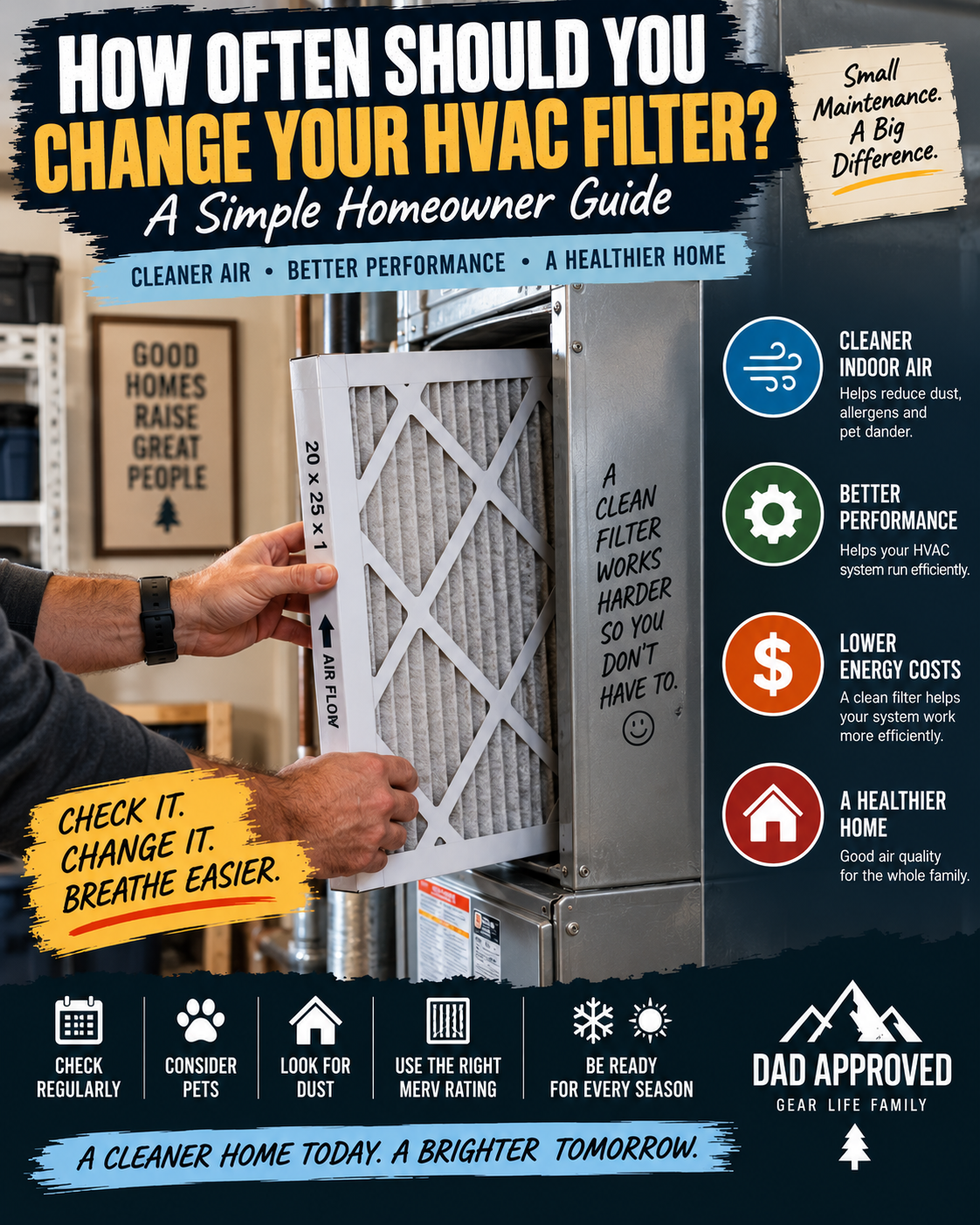
How often should you change your HVAC filter? If you’ve ever looked at the package, heard advice from an HVAC technician, and then searched online, you’ve probably received three different answers.
Every 30 days.
Every 90 days.
Every six months.
Very helpful.
The problem is that there isn’t one replacement schedule that works for every house. Filter thickness, HVAC runtime, pets, dust, outdoor air conditions and the filter itself can all affect how quickly it loads up.
The better approach is simple: check the filter regularly and replace it based on its condition and the manufacturer’s recommendations.
ENERGY STAR recommends checking HVAC filters every month, particularly during heavy-use seasons, and replacing them when dirty. It recommends changing them at least every three months as a general baseline. (ENERGY STAR)
Here’s how to figure out what makes sense in your house.
🌬️ How Often Should You Change Your HVAC Filter?
For many residential filters, 60 to 90 days is a common manufacturer recommendation, according to the EPA. But the EPA also points out that several factors determine how quickly a filter becomes dirty and recommends replacing it more frequently if it’s heavily soiled by replacement time. (US EPA)
That’s why I wouldn’t write “CHANGE EVERY 90 DAYS” on the furnace with a permanent marker.
Instead:
Check it monthly.
If it’s dirty, replace it.
If it still looks relatively clean, keep using it while staying within the filter manufacturer’s replacement guidance.
That’s considerably more useful than treating Day 90 like your filter suddenly turns into a pumpkin.
📅 Why Every 90 Days Isn’t a Universal Rule
Two identical filters installed in two different houses can have very different lives.
Think about what the filter is dealing with.
One home might have two adults, no pets, little dust and an HVAC system that barely runs during mild weather.
Another might have a large family, several pets, doors opening constantly and an HVAC system running for hours every day.
Those filters aren’t doing the same job.
Your replacement schedule can also change throughout the year. ENERGY STAR specifically recommends monthly inspections during heavy-use months in winter and summer. (ENERGY STAR)
So don’t get too attached to a calendar.
The filter itself gets a vote.
📏 Does HVAC Filter Thickness Matter?
Yes, but don’t assume that a thicker filter automatically means you can leave it installed forever.
Residential HVAC filters commonly range from about 1 to 5 inches thick, according to the EPA. (US EPA)
Thicker media filters are physically different from the common 1-inch filters found in many systems and may have different manufacturer-recommended replacement intervals.
The important part is using the type your system was designed to accept.
Don’t try to wedge a 4-inch filter into a 1-inch slot because the internet told you thicker filters last longer.
Your HVAC system is not a toaster.
Use the proper filter dimensions and follow the manufacturer’s instructions for that filter and system.
🐕 Do Pets Mean Changing HVAC Filters More Often?
They certainly can.
Dogs and cats introduce hair, dander and additional particles into a home. More material circulating through the HVAC system means more material available for the filter to capture.
That doesn’t mean every pet owner needs to replace a filter every 30 days.
It means pet households should pay closer attention to actual filter condition instead of assuming the longest advertised replacement interval will work for them.
If you inspect the filter after a month and it already looks heavily loaded, you’ve learned something useful about your house.
Check the next one sooner.
The same principle applies to larger households and homes with a lot of activity.
Your filter doesn’t care what the package promised.
It knows how you live.
🧹 What If Your House Gets Dusty Quickly?
Heavy dust is another reason to inspect the filter more frequently.
But there’s an important distinction here:
Your HVAC filter is primarily part of the HVAC system. It isn’t a magical whole-house cleaning machine.
A filter that becomes dirty unusually quickly could simply reflect conditions inside the home, heavy HVAC runtime or other environmental factors.
If you’re constantly replacing heavily loaded filters or noticing unusual amounts of dust despite normal cleaning, it may be worth looking beyond the filter itself.
Check for obvious problems and consider asking an HVAC professional whether the system has airflow, ductwork or filtration issues that deserve attention.
Don’t automatically solve every dust problem by buying the most restrictive filter on the shelf.
Which brings us to MERV.
🔢 What MERV Rating Should You Use?
MERV stands for Minimum Efficiency Reporting Value.
It measures a filter’s ability to capture particles in certain size ranges. Higher MERV ratings indicate greater capture efficiency for those tested particle sizes. (US EPA)
That leads to an easy assumption:
Higher number = always better.
Not quite.
The EPA recommends MERV 13, or the highest efficiency filter that your HVAC system’s fan and filter slot can accommodate. The agency also notes that homeowners may need an HVAC professional to determine what’s appropriate for a particular system. (US EPA)
So don’t choose a filter based solely on the biggest number printed on the package.
Check your equipment documentation or ask your HVAC professional what the system is designed to handle.
A $25 filter isn’t an upgrade if your system doesn’t like breathing through it.
🔥 Should You Change Your HVAC Filter Before Heating Season?
Check it before heating season.
Whether it actually needs replacement depends on its condition and the manufacturer’s guidance.
That’s an important difference.
If your filter is already dirty after a summer of air-conditioning use, replacing it before the heating system starts working hard makes sense.
If you recently installed a filter and it’s still in good condition, there’s no prize for throwing it away simply because the calendar says September.
This also pairs nicely with a general fall HVAC check.
When you’re testing the heat before winter, walk over and inspect the filter too.
Two-minute job.
No toolbox required.
Those are the best kind.
👀 How Can You Tell When an HVAC Filter Is Dirty?
You don’t need laboratory equipment.
Remove the filter according to your system’s instructions and actually look at it.
Some discoloration over time is normal. What you’re watching for is substantial accumulation of dust and debris across the filter media.
ENERGY STAR’s guidance is refreshingly straightforward: if the filter looks dirty after a month, change it. (ENERGY STAR)
Also pay attention to how quickly your filters become dirty.
If you repeatedly find that they’re heavily loaded after six weeks, waiting 90 days because that’s what you read somewhere doesn’t make much sense.
Your house has already given you the answer.
📐 How Do You Find the Correct HVAC Filter Size?
Start with the existing filter.
The dimensions are usually printed along the edge of the frame.
You’ll typically see three measurements representing:
Length × Width × Thickness
The EPA notes that residential filters come in various lengths and widths and commonly range from 1 to 5 inches thick. The filter should fit snugly without needing to be bent or crushed into place. (US EPA)
If the old filter is missing or you’re uncertain about the size, check the HVAC equipment documentation or filter cabinet.
And before removing the old filter, notice the airflow arrow printed on its frame.
Install the replacement in the correct airflow direction.
Taking a quick phone picture before pulling the old filter out can save you from standing there five minutes later wondering which direction it was facing.
Ask me how homeowners learn that trick.
🏠 A Simple HVAC Filter Routine That Actually Works
If you want one rule that’s easy to remember, use this:
Check your HVAC filter on the first day of every month.
You’re not necessarily changing it every month.
You’re checking it.
It takes about a minute and quickly teaches you how filters behave in your particular house.
You may discover yours routinely needs replacement after a month or two.
You may find that your filter and system are designed for a longer interval.
Either way, you’re making the decision based on your equipment, your filter and your house instead of a generic internet schedule.
And during heavy heating and cooling seasons, that monthly check lines up directly with ENERGY STAR’s recommendation. (ENERGY STAR)
The Bottom Line: How Often Should You Change Your HVAC Filter?
So, how often should you change your HVAC filter?
There isn’t one magic number.
Manufacturers commonly recommend replacement around 60 to 90 days, but actual filter life varies. ENERGY STAR recommends inspecting filters monthly and changing them when dirty, with three months serving as a general maximum baseline in its homeowner guidance. (US EPA)
The Dad Approved version is even easier:
Check it every month. Change it when it needs changing.
If your household consistently dirties filters faster, shorten the interval.
If you’re unsure which filter size, type or MERV rating your equipment can handle, check the manufacturer’s documentation or ask a qualified HVAC professional.
Your HVAC filter might be one of the least exciting things you own.
But considering how much money you’ve got sitting on the other side of it, giving it 60 seconds of attention every month isn’t a bad trade.
